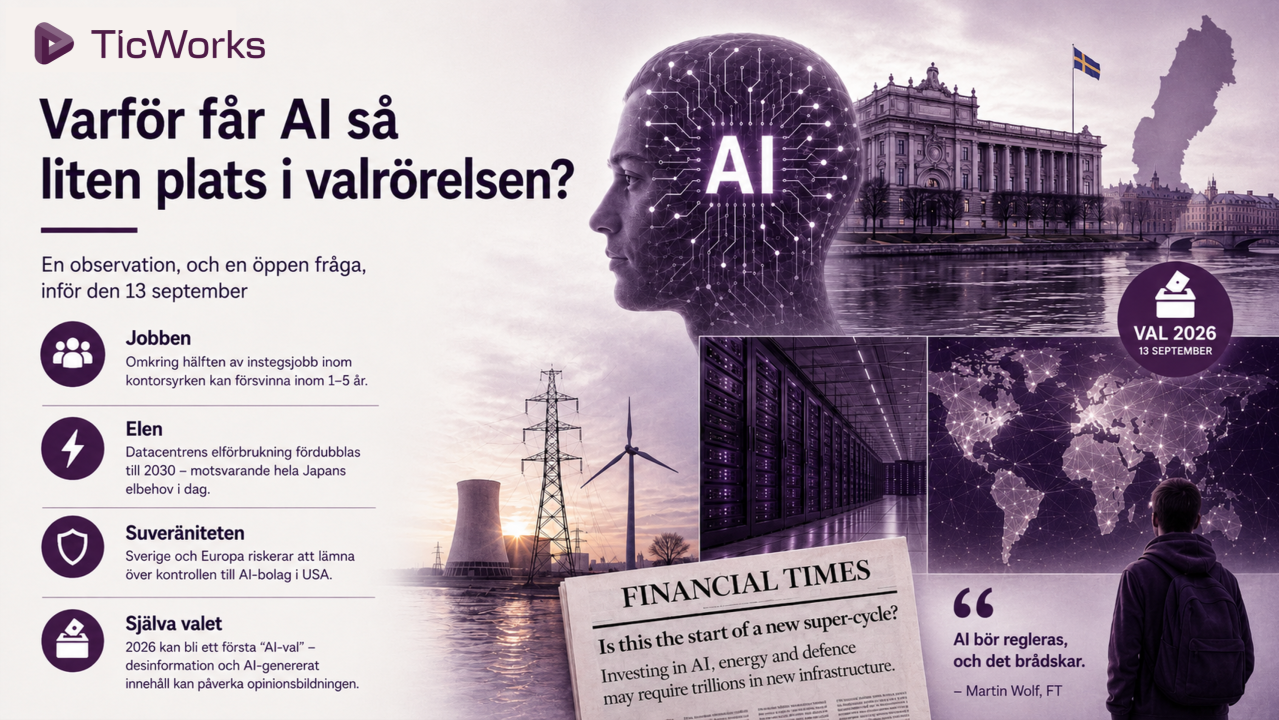
Why Is AI Getting So Little Attention in the Election Campaign?
An observation — and an open question — ahead of September 13

The Swedish election campaign is, quite rightly, focused on the economy, taxes, and household costs. These are issues that affect people’s wallets here and now, and it is understandable that they dominate the debate.
But alongside that debate, another discussion is taking place — one that has so far been almost entirely absent from the campaign: what AI could mean for the labour market, the economy, security, and democracy during the very parliamentary term that voters are now deciding on.
We are not AI experts. But we have noticed something that is difficult to ignore: just how seriously this issue is being taken by people who rarely agree on anything.
Take Rana Foroohar in the Financial Times, who asks whether we are at the beginning of a new “super-cycle” — a wave of investment in AI, energy, and defence that, in her view, could require trillions in new infrastructure. It is fundamentally an optimistic outlook: a structural transformation of the economy rather than a bubble waiting to burst.
Closer to the middle is Dario Amodei, CEO of AI company Anthropic, whose two essays from this year describe a technology with enormous potential, but also genuine risks. He explicitly argues against both doomsday predictions and hype. His position is measured: no one knows exactly how fast or how far this will go, but that uncertainty itself is a reason to prepare rather than wait.
At the more extreme end of the debate are considerably more dramatic scenarios. Research firm Citrini Research has published an explicit thought experiment — not a forecast — about a “global intelligence crisis” in 2028, in which AI displaces large parts of the service-sector workforce and triggers a downward economic spiral. At the furthest end of the spectrum is the scenario presented in Eliezer Yudkowsky and Nate Soares’ book If Anyone Builds It, Everyone Dies, in which sufficiently advanced AI could, in the worst case, threaten humanity’s very existence. Opinions differ sharply on how likely such scenarios are, but they illustrate just how wide the range of possible outcomes really is.
What is interesting is that these voices disagree profoundly about the conclusions, but agree on the premise: AI is not simply another technological wave that will come and go, but a more fundamental transformation, comparable to electricity or the Industrial Revolution. And they share one concern: our institutions are not keeping pace. Martin Wolf, also writing in the Financial Times, reaches a similar conclusion: AI should be regulated, and urgently, even if he doubts whether those efforts will ultimately succeed.
That this is not merely hypothetical — and that the stakes are already both real and political — became clear as recently as June 2026, when a U.S. export-control directive forced Anthropic to abruptly disable its two most capable models, Fable 5 and Mythos 5, for all customers worldwide, citing national security concerns. In other words, a government decision in Washington had immediate consequences for users around the world, including us at TicWorks. It became a concrete example of just how dependent Europe is on the U.S. administration.
This is where the connection to the election becomes tangible. A parliamentary term lasts four years, and several decisions made during that period will help determine how AI affects education, the labour market, electricity supply, and national defence. A few examples already closely connected to the Swedish political debate:
Jobs. Many young voters are already concerned that AI could undermine their future prospects. As early as 2025, Dario Amodei predicted that AI could eliminate around half of all entry-level white-collar jobs within one to five years. This is not an abstract threat, but a question about the value of the professions young people are currently training for.
Electricity. AI is driving up demand for electricity, directly linking it to the ongoing debate over nuclear power and wind power. The International Energy Agency (IEA) expects data-centre electricity consumption to roughly double to around 945 TWh by 2030 — equivalent to Japan’s entire electricity consumption today — and estimates that data centres will account for more than 20% of the total increase in electricity demand in advanced economies by then.
Sovereignty. A growing concern is that Sweden and Europe have handed too much control over to U.S.-based AI companies. This is as much a strategic issue as it is an economic one.
The election itself. Researchers have begun referring to 2026 as a potential first “AI election”, in which disinformation and AI-generated content could influence public opinion. According to the Swedish Internet Foundation, around a quarter of first-time voters have already used AI to better understand politics and societal issues.
None of this means that AI should displace other political issues. But the question of AI deserves more attention. When so many knowledgeable people, despite disagreeing strongly with one another, nevertheless agree that something significant is coming, it is difficult to see why the issue should not have a place in an election campaign.
That is where we stand.
The question we would like to leave with you is: do you agree — or is it reasonable for AI to remain a background issue?
Sources
Voices cited in the article
Rana Foroohar, “Is this the start of a new super-cycle?”, Financial Times, June 8, 2026.https://www.ft.com/content/d91cf0b4-2ed6-47b6-a9b1-46f87c52efc1(Headline as published in the print edition; the digital headline may differ.)
Martin Wolf, “Why the world must agree to regulate AI”, Financial Times, June 10, 2026.https://www.ft.com/content/8724874e-f387-4848-bfc4-2411d6f0797f
Dario Amodei, “The Adolescence of Technology”, January 2026.https://darioamodei.com/essay/the-adolescence-of-technology
Dario Amodei, “Policy on the AI Exponential”, June 2026.https://darioamodei.com/post/policy-on-the-ai-exponential
Citrini Research & Alap Shah, “The 2028 Global Intelligence Crisis” (explicitly presented as a thought experiment, not a forecast), February 2026.https://www.citriniresearch.com/p/2028gic
Eliezer Yudkowsky & Nate Soares, If Anyone Builds It, Everyone Dies (Little, Brown / Bodley Head, 2025).https://ifanyonebuildsit.com
Concrete examples and data
Anthropic, “Statement on the US government directive to suspend access to Fable 5 and Mythos 5”, June 12, 2026.https://www.anthropic.com/news/fable-mythos-access
Dario Amodei on AI and entry-level jobs (statement from May 2025), reported by Axios.https://www.axios.com/2025/05/28/ai-jobs-white-collar-unemployment-anthropic
International Energy Agency, “Energy and AI”, 2025.https://www.iea.org/reports/energy-and-ai
Swedish context
“Which issues look set to decide Sweden’s election?”, The Local, June 12, 2026.https://www.thelocal.se/20260612/which-issues-look-set-to-decide-swedens-election
WASP-HS, “AI in the Swedish Election Campaign – Democracy on New Terms”, February 2026.https://wasp-hs.org/ai-in-the-swedish-election-campaign-democracy-on-new-terms/
The Swedish Internet Foundation, “Swedes and the Internet: Election Special 2026”, April 2026.https://internetstiftelsen.se/om-oss/press/pressmeddelanden/ny-rapport-tiktok-och-ai-kan-paverka-valet/